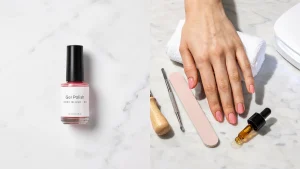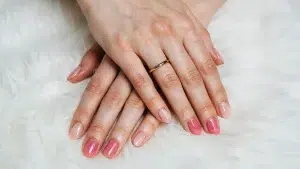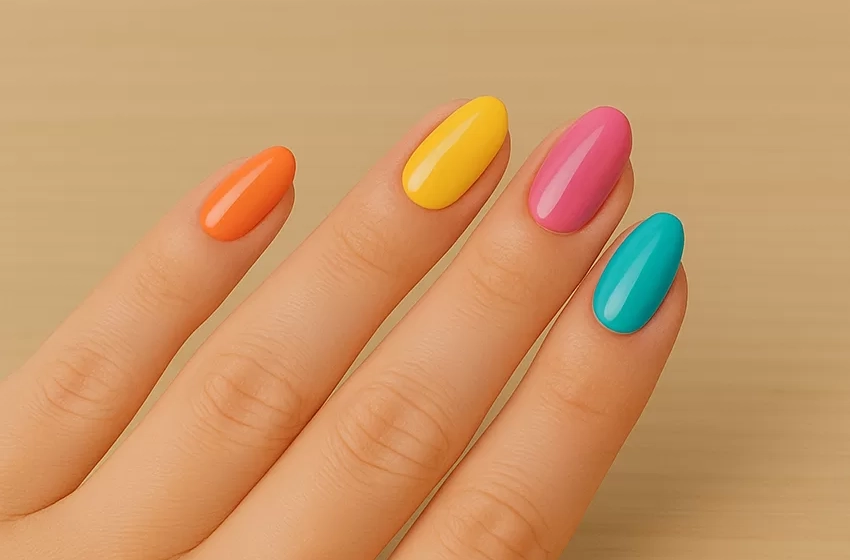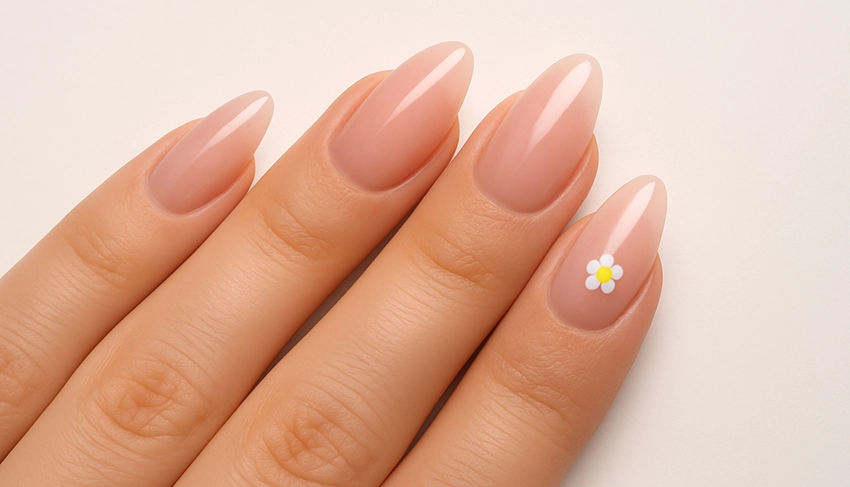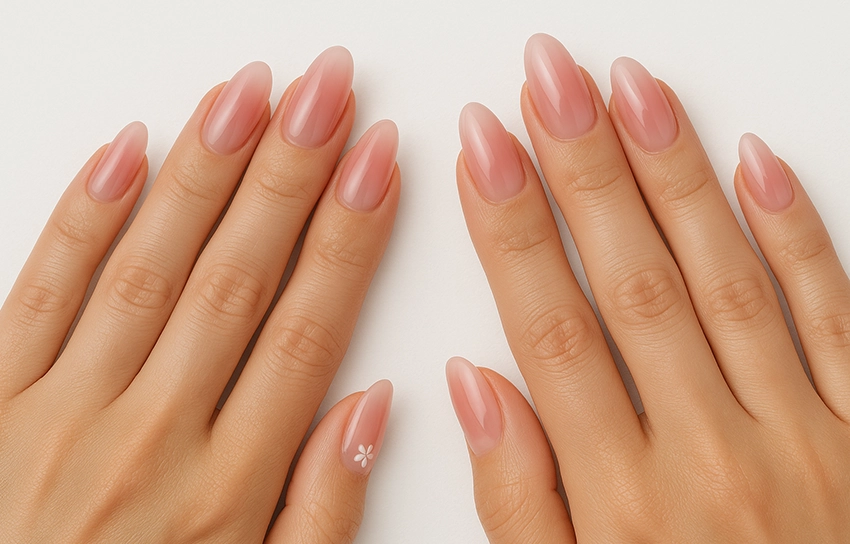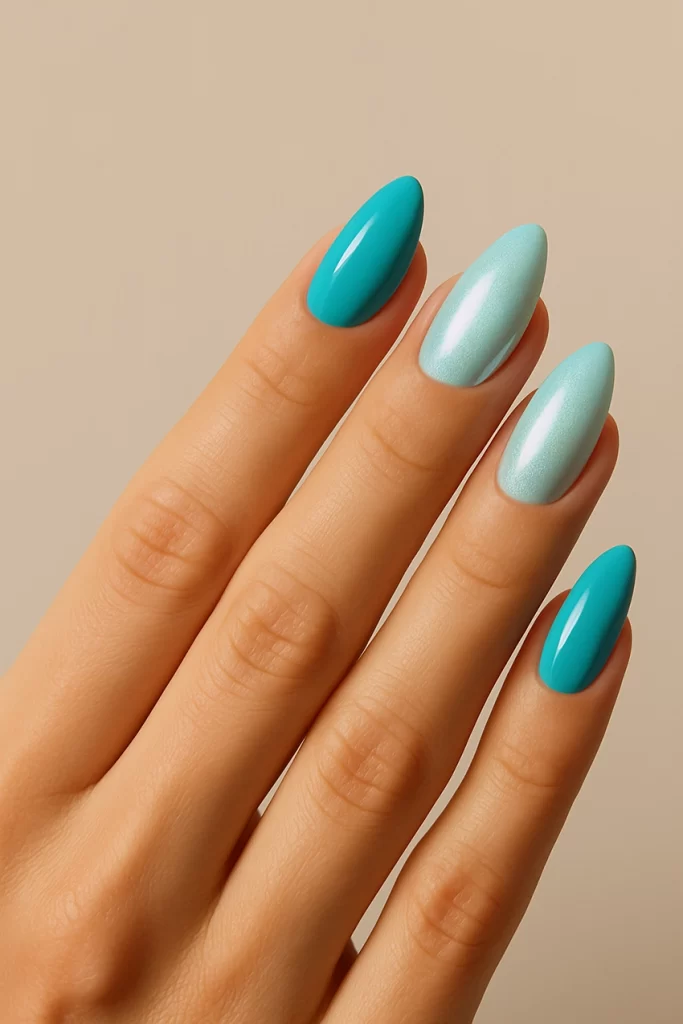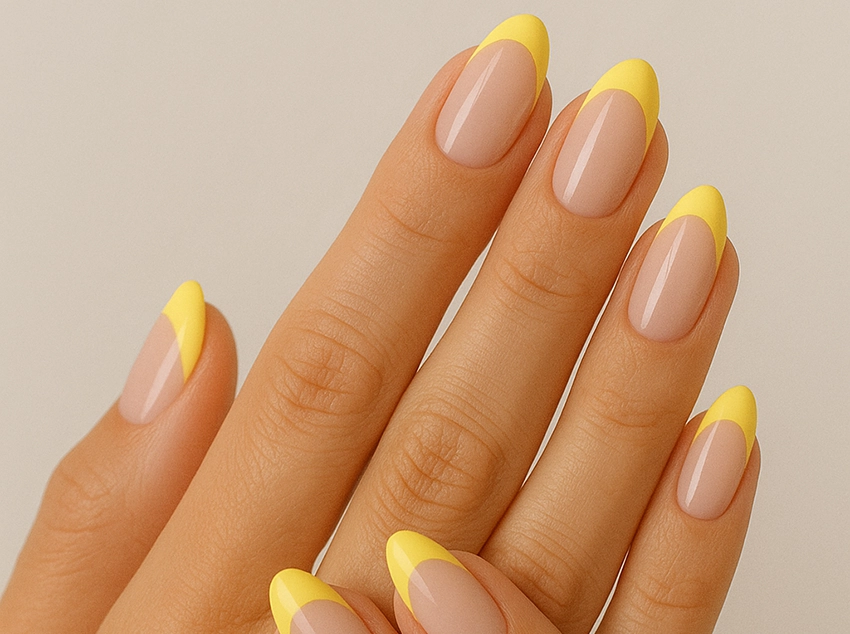
BIAB nails have quietly become the most requested manicure in the UK, and for good reason: they promise the strength of a gel overlay, the natural look of a bare nail, and – done properly – healthier natural nails underneath. If you have seen “BIAB” on every salon menu and still are not entirely sure what it is, this guide is for you. We will explain exactly what BIAB nails are, how they compare to gel polish, hard gel and acrylic, how to apply and remove them without damage, and whether they are the right choice for your nails in 2026.
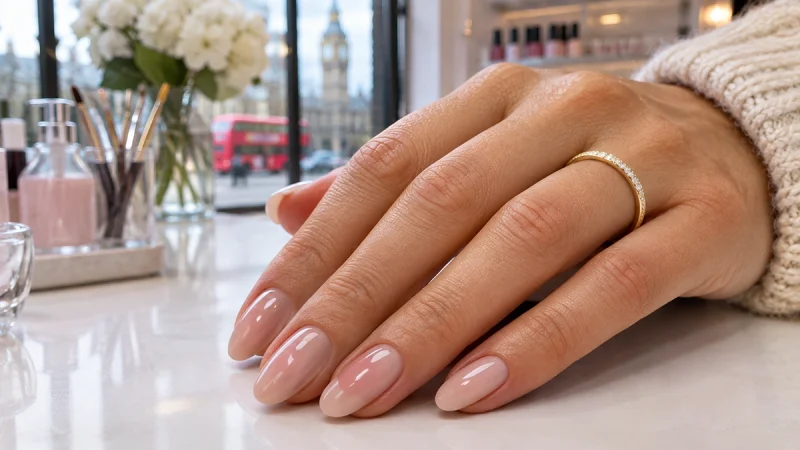
Quick Answer: BIAB stands for “Builder In A Bottle” – a soak-off builder gel applied like gel polish but thicker, creating a flexible protective layer that strengthens the natural nail. BIAB nails last three to four weeks, can be infilled rather than fully removed, and are gentler than hard gel or acrylic when soaked off correctly. They suit weak, bendy or peeling nails that need support to grow, and are the UK’s favourite low-damage way to get a strong, natural-looking manicure.
What Are BIAB Nails? Builder In A Bottle Explained
BIAB nails are manicures built on “Builder In A Bottle,” a soak-off builder gel that goes on with a brush like gel polish but is thicker and more flexible, forming a protective layer over the natural nail. The term was popularised by the UK brand The GelBottle, and it has since become a generic shorthand the way “hoover” stands in for vacuum – most salons use “BIAB” to mean any brush-on builder gel.
The key idea is structure. Ordinary gel polish is a thin colour coat that adds shine but little strength. BIAB is a self-levelling gel thick enough to reinforce the nail, laid down in a slightly domed layer with a subtle high point (the apex) that distributes impact so the nail flexes instead of snapping. That is why BIAB nails feel solid yet natural, and why they have become the go-to for anyone whose own nails bend or peel.
Crucially, BIAB is a soak-off gel, not a file-off hard gel. That means it can be removed with acetone rather than drilled away, which is a large part of its gentle reputation. Worn over your natural nail with no tips or extensions, BIAB nails are an overlay – a reinforcing jacket – rather than a set of false nails. They can also be used to add a little length or to coat nail tips, but the classic BIAB manicure is simply your own nails, strengthened.
Because BIAB sits in the same gel family as rubber base and builder gels, the categories blur. Our guide to rubber base gel benefits covers the softer, thinner cousin, while hard gel sits at the sturdier, file-off end of the same family. For most wearers, the headline is simple: BIAB nails are the strength of a builder gel with the ease of gel polish.
BIAB vs Gel Polish vs Hard Gel vs Acrylic
The fastest way to understand BIAB nails is to place them beside the systems they are confused with, because each solves a different problem.
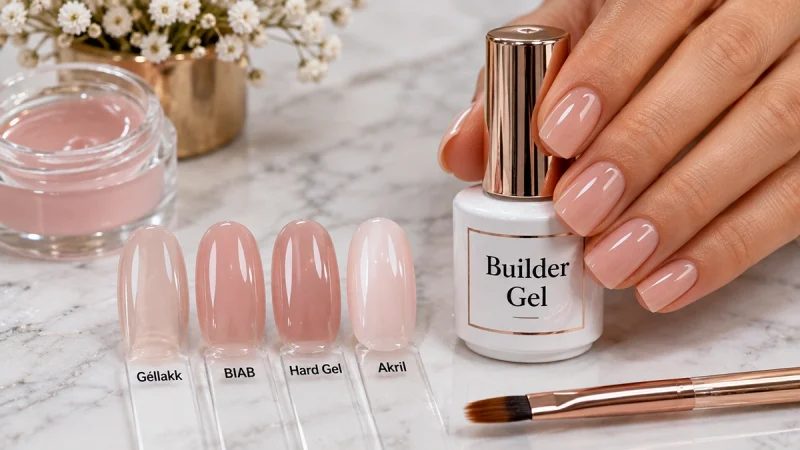
BIAB vs gel polish. Gel polish is colour; BIAB is structure. Gel polish is a thin two-to-three-coat film that chips or peels when your natural nail flexes underneath it, which is why weak nails struggle to hold it. BIAB lays down a thicker, flexible layer that stops that flexing, so colour on top lasts longer and the nail is protected. Many wearers apply BIAB as a base and gel polish colour over it, getting the best of both. The difference between a thin colour coat and a hybrid is worth knowing too, and our gel polish vs Shellac comparison untangles the related terminology.
BIAB vs hard gel. Both build strength, but removal is the dividing line. BIAB is soak-off: acetone dissolves it. Hard gel is file-off only: it must be drilled or filed away, which carries more risk in untrained hands. Hard gel is tougher and better for long sculpted extensions; BIAB is gentler, faster to remove and better for natural-length overlays. The full head-to-head is in our BIAB vs hard gel guide.
BIAB vs acrylic. Acrylic is a liquid-and-powder system sculpted into a hard, rigid enhancement, usually for length. It is strong but inflexible, involves stronger prep, and is filed off. BIAB is thinner, more flexible, soak-off, and designed to work with your natural nail rather than replace it. If your goal is dramatic length, acrylic still wins; if your goal is strong, healthy-looking natural nails, BIAB nails are the gentler route.
Here is the honest summary in a table:
| System | What it is | Strength | Removal | Best for |
| Gel polish | Thin colour coat | Low | Soak-off (10-15 min) | Colour on healthy nails |
| BIAB | Soak-off builder gel overlay | Medium-high, flexible | Soak-off (15-20 min) | Weak nails, natural strength |
| Hard gel | File-off builder gel | High, rigid | File-off only | Long sculpted extensions |
| Acrylic | Liquid + powder sculpt | High, rigid | File-off | Maximum length and durability |
The takeaway: BIAB nails occupy the sweet spot between fragile gel polish and heavy-duty extensions – strong enough to protect, gentle enough to remove at home.
How to Apply BIAB at Home: Step by Step
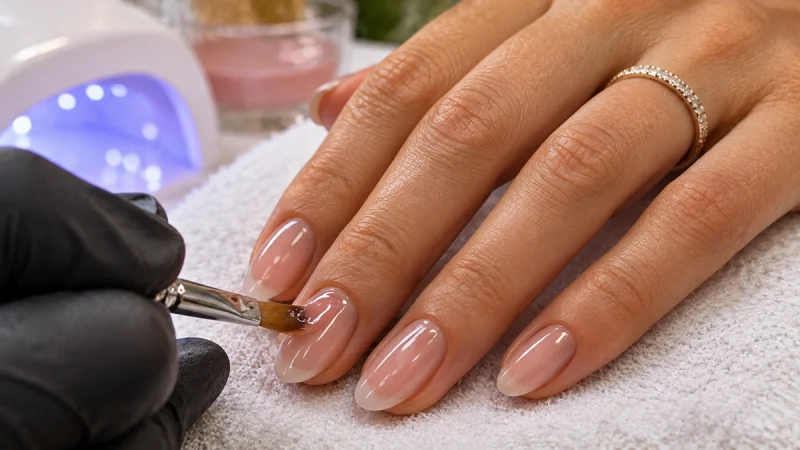
Applying BIAB nails at home is achievable with a little patience and the right prep, and the prep is where most results are won or lost. You will need a BIAB builder gel, a base and top coat (or a system where BIAB doubles as both), a lint-free wipe, cleanser, a UV or LED lamp, and a good cuticle oil.
Step 1: Prep the nail properly. Push back cuticles, remove any shine with a gentle buff, wipe with cleanser and dehydrate the plate. This stage decides whether BIAB nails last three weeks or lift in three days, and the full sequence is in our 7-step nail prep guide. Skipped prep is the number-one cause of lifting.
Step 2: Apply a thin base layer. A thin bonding or base coat, cured, gives BIAB something to grip. Keep it off the skin and cuticle.
Step 3: Lay down the BIAB. This is the skill step. Place a bead of builder gel in the centre of the nail and use the brush to guide it into a thin, even, slightly domed layer, leaving a hairline gap at the cuticle and sidewalls. Do not flood the edges. If the gel runs, you have used too much. Build the subtle apex just behind the centre of the nail, then cure fully per your lamp and brand timing.
Step 4: Refine and finish. Once cured, you can lightly file the surface to perfect the shape, wipe away dust, then apply gel polish colour if you want it, and seal with a capped top coat. Cap the free edge on every nail – this is what makes BIAB nails survive daily life.
Step 5: Oil daily. Finish with cuticle oil, and reapply it morning and night for the life of the manicure. Oil keeps the natural nail flexible under the BIAB and the skin healthy around it.
The realistic expectation: your first few attempts will be thicker or less even than a salon’s, and that is normal – BIAB control is a genuine skill. Thin layers, a clean cuticle gap and full curing are the three habits that fix almost everything. If colour keeps lifting even over BIAB, the culprit is nearly always prep rather than the BIAB itself.
How Long BIAB Lasts and Why
BIAB nails typically last three to four weeks, which is longer than ordinary gel polish and one of the main reasons for their popularity. The flexible builder layer stops the natural nail flexing and lifting the coat, so the manicure stays put through everyday wear.
What ends a BIAB manicure is usually growth, not failure. As the natural nail grows, a gap appears at the cuticle, and at the two-to-three-week mark that is the cue to either remove or – the clever part – infill. Because BIAB is a builder gel, a technician can file back the grown-out layer, fill the regrowth at the cuticle and refresh the top, extending the same set for weeks without a full soak-off. This infill cycle is gentler on the nail than repeated full removals and is a big part of why BIAB nails are marketed as a nail-growth system.
Several things decide where you land in that three-to-four-week range. Prep quality is the biggest factor, followed by how thickly and evenly the BIAB was applied, how well the free edge was capped, and your own lifestyle – lots of hot water, cleaning chemicals and using nails as tools all shorten wear. Daily cuticle oil, gloves for washing up and avoiding picking all push you toward the longer end.
There is a genuine nail-health angle here worth stating carefully. BIAB does not make nails grow faster – growth happens at the matrix, roughly a few millimetres a month regardless. What BIAB does is protect new growth from breaking before it reaches the length you want, which in practice means many people finally keep length they could never hold before. For the broader context on keeping natural nails healthy, the American Academy of Dermatology’s tips for healthy nails are a sensible, non-commercial baseline.
BIAB Removal Without Damage
BIAB removal is where the system earns its gentle reputation, but only if it is done patiently – and this is the single most important section for protecting your natural nails. Because BIAB is a soak-off gel, it dissolves in acetone and should never be peeled or forced.
The safe method. Gently file the shiny top layer to break the seal, then soak cotton pads in acetone, press one onto each nail, wrap in foil and leave for fifteen to twenty minutes – longer than gel polish because the layer is thicker. Check one nail: properly softened BIAB lifts away with gentle pressure from a wooden stick. If it resists, it is not ready – re-wrap and wait another five minutes rather than scraping. The complete technique, including timing and aftercare, is in our acetone soak-off guide.
The cardinal rule: never peel. Peeling or picking BIAB off takes layers of your natural nail with it, which is exactly the damage BIAB is meant to prevent. If you have ever ended up with thin, bendy nails after a gel manicure, forced removal – not the product – is almost always the reason, as our honest look at whether gel can ruin your nails explains in full.
Infill instead of removing. The gentlest option is often not to remove at all. Returning for an infill every few weeks keeps the natural nail covered and protected, so you only do a full soak-off occasionally – when you want a clean reset or a different look. Fewer full removals means less acetone exposure and healthier nails over time.
After any removal, rehydrate: cuticle oil, a rich hand cream, and a day or two of gentle care before the next set. BIAB nails are only as kind to your nails as the removal you give them, so if you take one thing from this guide, let it be patience with the soak-off.
Common BIAB Mistakes (and Fixes)
Even a system as forgiving as BIAB has a handful of recurring mistakes, and knowing them turns a frustrating set into a flawless one. These are the issues that fill salon re-booking slots – and every one has a simple fix.
Applying too thick. The most common error. A heavy BIAB layer floods the cuticle, takes forever to cure through and lifts early. Fix: use less product than feels natural, build structure with control rather than volume, and let the self-levelling gel do the work.
Flooding the cuticles and sidewalls. Gel touching skin is the fast track to lifting and, over time, to the irritation that leads some people to seek out HEMA-free gel options. Fix: leave a deliberate hairline gap around every edge.
Skipping or rushing prep. No amount of good BIAB technique survives poor prep. Lifting within days is almost always a prep failure, not a product failure – the exact chain our gel polish peeling guide traces.
Not capping the free edge. An uncapped tip is where chips and lifting begin, because the free edge takes the most wear. Fix: run a thin pass of BIAB and top coat over the very edge of every nail.
Under-curing. A layer that is too thick or a lamp that is mismatched leaves the gel under-cured, which feels tacky, lifts and – with any gel – raises the small risk of acrylate sensitisation. Fix: thin layers and the correct lamp and timing for your brand.
Peeling it off. Covered above, but it belongs on every mistake list because it undoes everything BIAB is for. Fix: always soak off or infill, never pick.
Expecting faster growth. BIAB protects growth, it does not accelerate it. Fix: set the right expectation – stronger nails that finally keep their length, not magically faster ones. Get these seven right and BIAB nails deliver exactly what the hype promises.
Are BIAB Nails Right for Your Nails?
BIAB nails are not for everyone, and the honest answer depends on your nails and your goals. Here is who should book in – and who might be better served elsewhere.
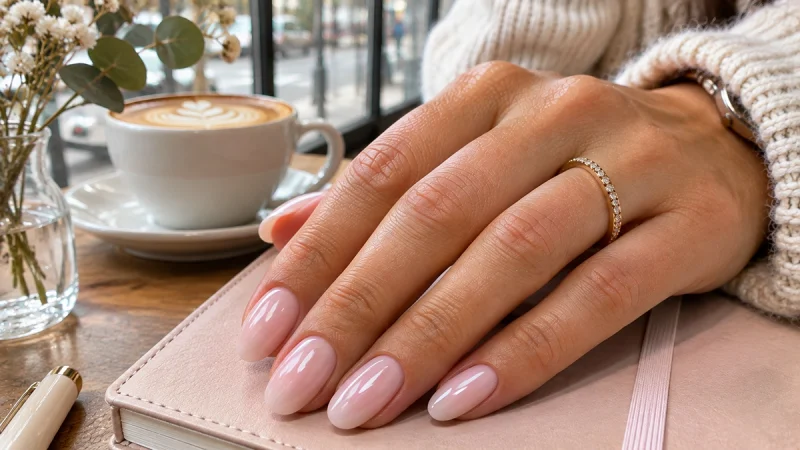
BIAB is ideal if your natural nails are weak, bendy, thin or peeling and you want to grow them stronger without extensions. It is the best fit for anyone who loves a natural-length, natural-looking manicure but cannot hold gel polish because their nails flex too much. It also suits busy people who value the three-to-four-week wear and the gentle infill cycle, and anyone trying to break a habit of acrylics and transition back to their own nails. For thin, stabilising-focused nails, it pairs naturally with the supportive philosophy behind rubber base and builder systems.
BIAB may not be your best choice if you want dramatic length or sculpted shapes – acrylic or hard gel will serve you better there. If you only want colour and your natural nails are already strong and healthy, ordinary gel polish is cheaper and lighter. And if you have had an acrylate allergy or persistent reactions to gel, BIAB is still a gel and will not solve that; the HEMA-free route and a patch test with a professional are the sensible path.
The UK context. BIAB is especially dominant in the UK market, where “BIAB manicure” is a standard menu line and most salons carry a builder-in-a-bottle system. If you are in the UK, BIAB nails are easy to find and competitively priced; elsewhere you may need to ask specifically for a builder gel overlay, which is the same thing under a different name.
The deciding question is simple: do you want strong, healthy, natural-looking nails you can actually grow? If yes, BIAB nails are very likely the manicure you have been looking for – just commit to the gentle removal and the daily oil, and they will look after your nails as much as your nails look after the look.
Your BIAB Nails Questions Answered
What are BIAB nails exactly?
BIAB nails are manicures built on “Builder In A Bottle,” a soak-off builder gel applied with a brush like gel polish but thicker, forming a flexible protective layer over the natural nail. The term comes from the UK brand The GelBottle and is now shorthand for any brush-on builder gel. Worn over your own nails as an overlay, BIAB adds strength and a natural look, and can be worn clear or under colour.
How long do BIAB nails last?
BIAB nails typically last three to four weeks, longer than ordinary gel polish, because the flexible builder layer stops the natural nail flexing and lifting the coat. What usually ends a set is cuticle regrowth rather than failure, and at that point you can infill to extend the same manicure instead of removing it. Good prep, thin application, a capped free edge and daily cuticle oil all push wear toward the longer end.
Are BIAB nails bad for your nails?
No – applied and removed correctly, BIAB is one of the gentler systems and is often used to help weak nails grow. The damage people blame on BIAB almost always comes from forced removal: peeling or picking takes layers of natural nail with it. Soak it off patiently in acetone or have it infilled, oil daily, and BIAB protects rather than harms. As a gel, it will not suit anyone with an acrylate allergy.
What is the difference between BIAB and gel polish?
Gel polish is a thin colour coat that adds shine but little strength, so it chips and peels when weak nails flex. BIAB is a thicker, flexible builder gel that reinforces the nail and stops that flexing, so it lasts longer and protects growth. Many people use BIAB as a strengthening base with gel polish colour on top. In short: gel polish is colour, BIAB is structure.
Can you apply BIAB nails at home?
Yes, with practice. You need a BIAB builder gel, base and top coat, a UV or LED lamp, cleanser and cuticle oil. The skill is laying a thin, even, slightly domed layer with a gap at the cuticle, then curing fully and capping the free edge. Prep is the biggest factor in whether it lasts. Early attempts are usually thicker than a salon’s; thin layers and clean edges fix most beginner issues.
How do you remove BIAB nails without damage?
Lightly file the shiny top layer, soak acetone-dampened cotton on each nail under foil for fifteen to twenty minutes, then gently push off the softened gel with a wooden stick. If it resists, re-wrap and wait rather than scraping. Never peel or pick, which strips the natural nail. Even gentler is to infill instead of removing, so you do a full soak-off only occasionally. Rehydrate with oil afterward.
Is BIAB better than acrylic?
Neither is better outright – they serve different goals. BIAB is thinner, flexible, soak-off and designed to strengthen natural nails at natural length. Acrylic is rigid, sculpted, filed off and built for dramatic length and maximum durability. If you want strong, healthy-looking natural nails, BIAB wins; if you want long, sculpted enhancements, acrylic does. Many people use BIAB specifically to transition away from acrylic back to their own nails.
BIAB nails have earned their place as the UK’s favourite manicure by doing something genuinely useful: giving weak natural nails the strength to grow, with the ease of gel polish and none of the drilling of hard systems. Get the prep right, keep the layers thin, remove them patiently or infill instead, and oil daily – and BIAB nails will reward you with strong, natural-looking hands that only get healthier the longer you wear them.
Our other content
- Nail inspiration on Pinterest
- Daily nail content on Facebook
- Nail tutorials on TikTok
- Full nail videos on YouTube
- Behind the manicure on Instagram
Kitten
Testing gel systems, lash treatments and at-home nail techniques, with every method tried before it is recommended.